
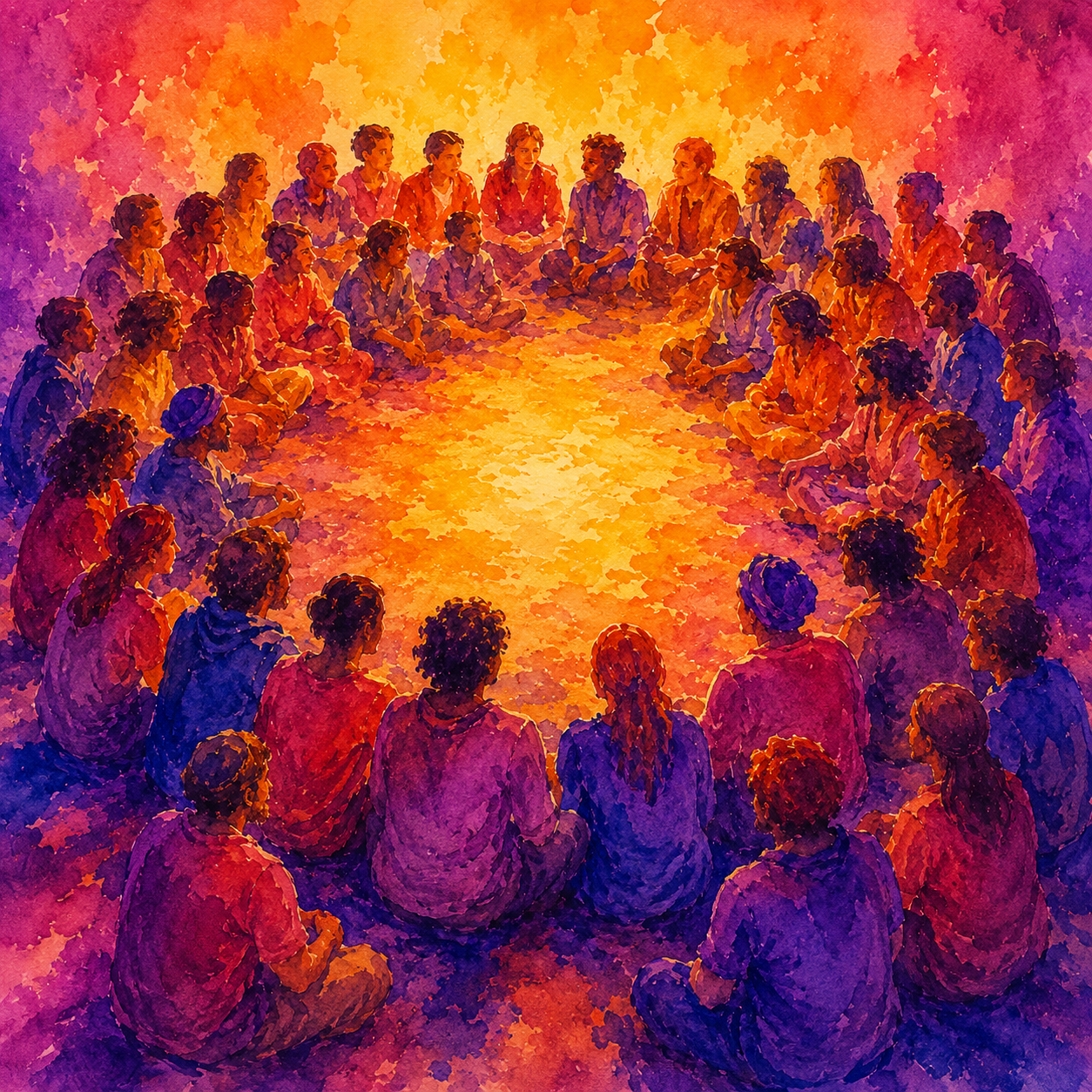
There is a line in Acts 2 that we may pass over too quickly.
After the wind, after the fire, after Peter’s sermon, after the crowd are cut to the heart, after three thousand are baptised, Luke tells us this:
“They devoted themselves to the apostles’ teaching and fellowship, to the breaking of bread and the prayers.”
It sounds so simple. Almost ordinary.
Teaching. Fellowship. Bread. Prayer.
No branding. No strategy document. No clever programme. No desperate attempt to make the Church attractive. Just a newly formed people, gathered by the Holy Spirit, learning how to live together in the life of Jesus.
And that is the point.
Pentecost does not create a religious audience. It creates a community.
The Church is not first an event people attend. It is not first a building people enter. It is not first an institution people support. It is not even first a collection of individuals who happen to share similar beliefs.
The Church is a people called into being by the Holy Spirit.
That sounds obvious until we hold it up against much of our actual church life. For many of us, church has quietly become something we go to rather than a people we belong to. We attend worship. We sit in rows. We receive the service. We drink coffee afterwards, perhaps. Then we return to our separate lives.
There is nothing wrong with attendance. There is nothing wrong with services. There is certainly nothing wrong with coffee. But Acts 2 presses a deeper question upon us.
Are we merely attending, or are we being gathered?
That is not a small difference. An audience can gather around a performance. Consumers can gather around a product. Volunteers can gather around a project. But the Church gathers around the living presence of God.
Acts 2 is not merely history. It is a mirror.
And when it looks at us, it asks whether we have confused proximity with communion.
People can sit in the same building for years and still not share life. They can exchange peace every Sunday and remain strangers. They can serve on the same rota and never become brothers and sisters. They can agree about doctrine and never learn how to love one another.
The early Church was not perfect. We must not romanticise it. The New Testament is full of conflict, hypocrisy, fear, exclusion, confusion, and failure. But there is one thing we cannot miss: the Spirit did not fall on isolated individuals so they could enjoy private spiritual experiences. The Spirit formed a people.
That matters because we live in a culture that trains us to think of ourselves as individuals first.
We choose our own preferences, curate our own identities, protect our own boundaries, and leave when something no longer suits us. We are told, in a thousand subtle ways, that freedom means keeping our options open. Stay only as long as it works for you. Commit only until something better appears. Belong, but not too deeply. Love, but not at too much cost.
Then we bring that formation into the Church.
We look for a church that fits us. The music we like. The preaching we prefer. The people we find comfortable. The theology we already agree with. The level of commitment we can manage without too much disruption.
But Acts 2 describes something far more demanding and far more beautiful.
The believers “devoted themselves.”
That word matters. They did not merely show interest. They did not occasionally drop in. They did not consume spiritual content. They devoted themselves.
They gave themselves to a shared way of life.
This is where the Benedictine theme of stability becomes so important. Stability is not glamorous. It rarely feels exciting. It does not look like revival if we imagine revival only as intensity and emotion. Stability is the quieter miracle of staying: staying with God, staying with one another, staying in the place where Christ is forming us.
Michael Casey’s reading of the Rule of St Benedict helps us see that monastic life is not primarily an escape from the world but a school for being remade in community. His themes of distinctiveness, mutuality, dispossession, contemplation, holiness and perseverance all point toward a life in which people stop treating faith as a private possession and begin learning the costly art of shared conversion.
That is not remote from parish life. It may be exactly what parish life needs.
Because the truth is that many churches are not short of activity. They are short of shared life. They have committees, services, events, meetings, and rotas, but often lack the deeper fabric of belonging. They know how to organise, but not always how to abide. They know how to welcome people at the door, but not always how to weave them into a family. They know how to keep the institution moving, but not always how to become a dwelling place for God.
Tyler Staton gives us helpful language here. He speaks of the gap between “biblical rumor and actual life,” and says spiritual health involves that gap narrowing until the promise of Scripture becomes lived reality. He identifies the Holy Spirit as the one who narrows that gap, bringing the story off the page and into ordinary experience.
That is precisely what Acts 2 exposes.
Most of us do not doubt that Acts 2 happened. The harder question is whether we expect anything like it now.
Do we expect the Holy Spirit to create a people among us? Do we expect strangers to become family? Do we expect possessions to be held more lightly? Do we expect prayer to become central rather than decorative? Do we expect worship to spill into homes, meals, money, forgiveness, and public witness?
Or have we quietly settled for less?
There is a painful honesty needed here. Much of what we call church community is actually friendliness. Friendliness is good. It matters. A cold church is a contradiction of the Gospel. But friendliness is not the same as fellowship.
Fellowship, in Acts 2, is not polite sociability. It is shared life in the Spirit.
It means lives becoming entangled. It means burdens being carried. It means money being seen differently. It means homes being opened. It means prayer becoming common. It means people being missed when they are absent, not because attendance statistics have dropped, but because the body is incomplete without them.
It means the lonely are not left to be lonely. The poor are not left to struggle invisibly. The grieving are not given a few kind words and then forgotten. The awkward are not quietly avoided. The wounded are not treated as inconvenient. The young are not patronised. The old are not sidelined. The neurodiverse are not made to feel like problems to manage. The disabled are not welcomed in theory while excluded in practice. LGBTQ+ people are not spoken about as issues instead of embraced as people bearing the image of God.
But even here we need to be careful with our language.
It is not enough for the Church to say that it “tolerates” people who are different.
Tolerance may sound generous in a divided world, but it is a thin and chilly word. We tolerate things we would rather not have to deal with. We tolerate noise, inconvenience, discomfort, delay. To say that a church tolerates LGBTQ+ people, disabled people, neurodiverse people, poor people, divorced people, wounded people, or anyone else is not yet good news. It means, at best, “You may remain here, provided you do not disturb us too much.”
That is not the Gospel.
Yet even the word “acceptance” may not take us far enough. Acceptance sounds warmer than tolerance, and often it is. But it can still leave the power in the hands of the settled group. It can still imply that there is an “us” at the centre and a “you” at the edge. We have decided to accept you. We have decided to allow you in. We have decided to make room.
But the Church is not a private club with generous gatekeepers.
The deeper Christian word is belonging.
Deeper still, communion.
In the body of Christ, people are not included by the permission of the majority. They are not guests in someone else’s house. They are not problems to be managed, issues to be discussed, or exceptions to be accommodated. They are members of the body.
That changes everything.
A church does not “accept” an LGBTQ+ person as though granting entry to an outsider. A church receives a sibling already loved, called, and dignified by Christ.
A church does not “tolerate” someone with ADHD because they are energetic, inattentive, disruptive, intense, or hard to fit into inherited patterns of worship and committee life. A church recognises that this person may notice, question, connect, pray, and perceive in ways the rest of the body desperately needs.
A church does not “make space” for disabled people as an act of charity. A church confesses that without them the body is incomplete.
This is not a modern political addition to the Gospel. It is at the heart of what the Spirit does. At Pentecost, the Spirit breaks open the boundaries of language, culture, and expectation. People from many nations hear the mighty works of God in their own tongues. The miracle is not only that people speak. It is that people are heard.
One of the first signs of the Spirit-filled Church is that people who were once treated as outsiders discover that the good news can be spoken in the language of their own life.
So when Acts 2 holds up the mirror, we must ask: who has learned, from our common life, that they do not really belong? Who has sat among us for years and remained unseen? Who has adapted themselves to fit in while we called ourselves welcoming? Who has quietly left because our fellowship was not deep enough to notice their pain?
These are not comfortable questions. But they are necessary ones.
Because the Spirit does not gather us into a vague togetherness. The Spirit gathers us into the life of Jesus.
And the life of Jesus is always concrete. Tables. Bodies. Touch. Tears. Bread. Forgiveness. Children. Lepers. Tax collectors. Women listened to as disciples. The hungry fed. The ashamed restored. The powerful challenged. The lost sought. The dead raised.
The Church in Acts continues this embodied life. They break bread in homes. They share possessions. They pray. They worship. They eat with glad and generous hearts. Their life together becomes visible enough that others notice.
This is crucial. The first Christian witness after Pentecost is not only preaching. It is a community.
Peter does preach, of course. Words matter. The Gospel must be announced. But the sermon gives birth to a people whose common life becomes part of the proclamation.
A Church that does not share life will struggle to proclaim new life.
This may be one reason so much mission feels strained today. We are often trying to persuade people to believe Christian claims while offering them church communities that do not look much like the Kingdom Jesus announced. We invite people to attend, but Acts shows us a Church inviting people into a whole new way of being human.
Not perfect. Not tidy. Not conflict-free.
But alive.
And perhaps this is where we need repentance. Not only repentance for personal sins, though certainly that. Not only repentance for institutional failures, though certainly that too. We may need to repent of making Church too thin.
We have made belonging too optional.
We have made attendance too central.
We have made commitment too light.
We have made privacy too sacred.
We have made welcome too passive.
We have made inclusion sound like an act of our generosity rather than a fact of Christ’s body.
We have made the gathered life of the Spirit into something that can be fitted around everything else.
But Acts 2 will not let us do that easily.
“They devoted themselves.”
There is no renewal of the Church without a renewal of devotion.
Not frantic activity. Not burnout. Not clerical control. Not guilt-driven volunteering. Devotion is deeper than busyness. Devotion is the reordering of love. It is what happens when the Spirit teaches us that Christ is not one interest among many, but the centre around which all of life is gathered.
This is where stability becomes a gift. Stability says: I will not treat this community as a product. I will not leave simply because I am bored, offended, unnoticed, or asked to grow. I will stay long enough for Christ to meet me through these people. I will allow the ordinary frustrations of community to become part of my conversion.
That does not mean remaining in places of abuse or manipulation. Stability is not a command to endure harm. The Church must never use the language of commitment to trap people in destructive situations. But in a culture of constant exit, there is still a holy discipline in staying where love is difficult and growth is slow.
Every real community will disappoint us. That is not a sign that something has gone wrong. It is the place where discipleship begins.
The people in Acts 2 had to learn this. So do we.
The Spirit gathers people we would not have chosen. That is part of the mercy. Left to ourselves, we gather with people like us: people who think like us, vote like us, speak like us, worship like us, and irritate us as little as possible. The Holy Spirit is far less efficient and far more loving. The Spirit gathers Jews and Gentiles, rich and poor, women and men, slaves and free, locals and foreigners, the respectable and the scandalous.
The Spirit creates a body.
And a body cannot be curated like a social circle.
This is why Church is so hard. It is also why Church is so holy.
In a true Christian community, I do not get to decide that I have no need of you. I do not get to keep my distance from the parts of the body that embarrass me. I do not get to love only the people who make me feel at ease. I do not get to pursue a private spirituality detached from the wounds, needs, gifts, and annoyances of others.
The Holy Spirit gathers us into dependence.
Dependence on God, first of all. But also dependence on one another. That may be one of the hardest lessons for the modern Church to relearn. We have been trained to admire independence. We prefer to be useful rather than needy. We prefer to serve rather than be served. We prefer to manage rather than receive.
But the Church is not a gathering of the competent. It is a communion of the dependent.
At Pentecost, no one possesses the Spirit as a private achievement. The Spirit is given. The Church receives its life. That means the Church begins not in control, but in gift.
Perhaps that is why the early believers could hold their possessions lightly. Once life itself has been received as gift, everything else begins to look different. Money looks different. Homes look different. Food looks different. Time looks different. The person beside me looks different.
This is not forced collectivism. It is not romantic poverty. It is the economic fruit of the Spirit. They shared because they had been gathered into a life where the old boundaries of mine and yours had begun to loosen.
That may be one of the clearest signs of whether we are becoming the Church again.
Not whether we have impressive services.
Not whether our language is contemporary or traditional.
Not whether we can explain our vision statement.
But whether, among us, people are being gathered into such a depth of belonging that fear begins to loosen its grip.
Fear says, “Protect yourself.”
The Spirit says, “You belong to Christ, and therefore to one another.”
Fear says, “There will not be enough.”
The Spirit says, “Break the bread.”
Fear says, “Stay in control.”
The Spirit says, “Receive.”
Fear says, “Keep your distance.”
The Spirit says, “Devote yourselves.”
This is not soft or sentimental. It is one of the most demanding visions of Church imaginable. It asks far more of us than attendance. It asks for our lives.
But it also offers far more than attendance can ever give.
Many people in our congregations are tired. Some are lonely. Some are faithful but dry. Some are busy in church but spiritually hungry. Some have served for years and quietly wonder whether this is all there is. Some have been hurt by the Church but still cannot let go of Jesus. Some are new and unsure whether there is room for them. Some are watching from the edges, wondering whether Christian community is real or just another institution trying to survive.
Acts 2 speaks to all of us.
It says: the Church was never meant to be a religious service provider. It was never meant to be a voluntary association of like-minded individuals. It was never meant to be a heritage society, a moral lobby, a social club, or a weekly spiritual top-up.
The Church is what happens when the Holy Spirit gathers people into the life of the risen Jesus.
So the question is not simply, “How do we get people back to church?”
The deeper question is, “What kind of church are we asking them to come back to?”
A crowd?
An audience?
A programme?
A building?
A memory?
A club that tolerates difference?
A community that accepts outsiders on its own terms?
Or a people alive with the presence of God, where each person can say, truthfully and without fear: I am not here by permission. I am here by gift.
Acts 2 is not merely history. It is a mirror.
And if we are willing to look, really look, we may find both judgement and invitation there. Judgement, because we have often settled for a thin and manageable version of Church. Invitation, because the same Spirit who gathered them has not gone away.
The Holy Spirit still gathers.
Still reconciles.
Still gives courage.
Still opens homes.
Still breaks bread.
Still teaches us to pray.
Still forms strangers into family.
Still makes the Church possible.
The question is whether we are willing to be gathered.
Not merely counted.
Not merely entertained.
Not merely consulted.
Not merely used.
Not merely tolerated.
Not merely accepted.
Gathered.
Gathered into prayer. Gathered into repentance. Gathered into shared life. Gathered into costly love. Gathered into the patient stability of belonging to Christ and, through Christ, to one another.
Because the Church is not something we attend.
The Church is something the Spirit makes us become.